
Water Buffets – What’s all the fuss?
Water Buffets – What’s all the fuss?
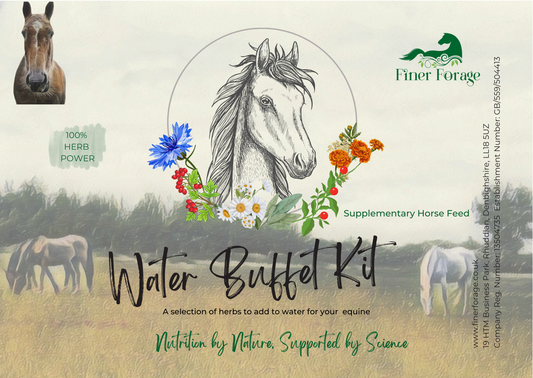
At Finer Forage, we love a Water Buffet: that’s why we crafted our best selling, ever-popular Water Buffet range. And boy, are they popular! So much so, other companies have followed in our footsteps and brought out kits, and many people make their own. And to that, we say: Hooray! We are totally behind anything that benefits our horses, and love that all the Water Buffet Goodness is getting out there. But, what are Water Buffets, what do they do and why do we use them? In this Blog post, our resident nutritionist, Nia Cooke (MSc, BSc(hons), DEP, ProDip EqNut) will look at these questions, using her Masters Degree in Animal Nutrition to explore the science behind selections and the all important do’s and don’ts when making your own water buffet – so read on!
Water buffets, at their heart, are a way of providing horses with free selection of herbs or herbal blends. By putting small amounts of herbs in buckets of water, and offering them to your horse or herd, you are enabling them to sample, select and choose from a variety of botanical options: a buffet of herbally infused water!
Water buffets provide enrichment: something interesting for your horse to explore. Horses are naturally grazers and browsers: they have evolved to be able to explore hundreds of different plants in their natural environment, and water buffets are a great way to allow horses to explore plants that they won’t find in their paddocks.
Allowing your horse to explore a variety of herbs in this way allows them to sample and select herbs that they particularly like, encourages them to drink more, and can be an interesting exercise in self selection and communication between you and your horse.
Zoopharmacognosy – is there any proof?
Zoopharmacognosy - literally meaning “animal self‑medication” - is the study of how animals instinctively select plants, clays, minerals, and other natural substances to support their own health. In horses, this concept is often applied through self‑selection” sessions, where the animal is offered a range of herbs or essential oils and allowed to choose what it wants. Water buffets are another tool for exploring this phenomenon. The idea is that horses possess innate sensory and behavioural cues that guide them toward substances with pharmacological relevance. The term was popularised by biologist Dr. Michael Huffman, whose work with chimpanzees in the 1990s demonstrated deliberate ingestion of medicinal plants such as Vernonia amygdalina to treat parasitic infections (Huffman, 1997; Huffman & Seifu, 1989). These foundational studies underpin the broader theory that animals can detect and respond to the bioactive chemistry of plants in ways that support homeostasis.
Evidence for zoopharmacognosy in horses is suggestive, but not yet robust. There are observational studies showing that domestic horses will selectively consume herbs such as cleavers, dandelion, hawthorn, and willow when given free choice, particularly when experiencing inflammation, digestive discomfort, or seasonal metabolic stress. Research in other herbivores provides stronger support: for example, sheep have been shown to self‑select tannin‑rich forages when parasitised (Villalba et al., 2010), and goats adjust intake of bitter plants based on physiological need (Provenza et al., 2003). These findings imply that herbivores possess sophisticated feedback systems linking taste, olfaction, and internal state. However, controlled trials in horses remain limited, but with plenty of anecdotal evidence and practitioner experience in support of results, if not than peer‑reviewed data as yet. In short, zoopharmacognosy is a plausible, biologically grounded concept with strong evidence in wild species, but equine‑specific proof is still emerging and should be approached with curiosity, caution, and scientific rigour.
Gut benefits
Water buffets support equine gut health by encouraging steady, voluntary hydration and providing natural plant infusions that gently modulate the hindgut environment. When horses drink more frequently - especially from water enriched with mild, microbiome‑friendly herbs like marshmallow, chamomile, cleavers, or rosehips: the hindgut maintains better fluid balance, allowing fibre to ferment more evenly and reducing the risk of acidosis or microbial die‑off. The phytonutrients in these herbs act as prebiotic substrates, feeding beneficial bacteria, while their soothing compounds help stabilise the gut lining and reduce inflammatory stress that can disrupt microbial populations. By offering multiple phytonutrient profiles, water buffets also tap into a horse’s natural self‑selection instincts, encouraging them to choose what their body needs and supporting a more diverse, resilient hindgut microbiome.
What to put in your buffet.
You can have fun and be creative when making up a water buffet: straight herbs, mixes of herbs, herbal blends or salts all make great additions to water. Straight herbs can be added as powder, or as whole flowers. Some horses aren’t so keen on having the flowers floating in them, whereas others love it (Mousey, my Section A, loves bobbing for marigolds!). If your horse isn’t so keen on floaty bits in their buffet, you can make a tea using hot water (avoid using boiling water as this destroys some useful properties in some plants) and then dilute it down with cold water to make an infusion type drink.
Herbal blends can also be offered in a water buffet, my herd particularly like Oscar’s Stand and De-Liver in their water bucket currently, but I have also offered Sultan’s Ulsa-Off, Shakespeare’s Soothe and Shine, and Hooch’s EMS Ease previously with great success.
Popular Herbs and their Properties
Herbs have many properties, micronutrients and phytonutrients – micronutrients include vitamins and minerals, and phytonutrients are the plant power nutrients offering biological properties such as antioxidant, anti-inflammatory, calming and so on.
Here are some examples of popular water buffet herbs:
Chamomile: Sweet to the taste, so may encourage drinking in the warm weather or when away from home. Chamomile’s micronutrient content includes potassium calcium and magnesium. Its flowers are rich in flavonoids such as apigenin, luteolin, quercetin, and rutin, which contribute antioxidant, anti‑inflammatory, and calming effects. Chamomile also contains sesquiterpenes like α‑bisabolol and chamazulene, known for anti‑inflammatory and antimicrobial activity, alongside coumarins (herniarin, umbelliferone) and phenolic acids (caffeic, ferulic) that further support gastrointestinal soothing and mild sedative actions.
Marigold and Cleavers: Sister herbs famed for their lymphatic support properties, a tasty and popular water buffet option. Marigold (Calendula officinalis) and cleavers (Galium aparine) offer potassium, calcium, and magnesium. Marigold is rich in triterpenoid saponins, carotenoids (notably lutein and zeaxanthin), flavonoids (quercetin, isorhamnetin), and sesquiterpene lactones, giving it anti‑inflammatory, epithelial‑repairing, and antioxidant properties. Cleavers contains iridoid glycosides (asperuloside, monotropein), coumarins, phenolic acids, and flavonoids, alongside a notable profile of chlorophyll‑rich polysaccharides that support lymphatic flow and mild diuretic action. Together, they deliver high bioactive phytochemistry, making them useful in blends aimed at soothing tissues, supporting detoxification pathways, and modulating inflammation.
Liquorice root: Sweet and tasty with several health boosting properties. Liquorice root contains traces of potassium, calcium, magnesium, and B‑vitamins. Its real power comes from its phytonutrient profile, dominated by triterpenoid saponins, especially glycyrrhizin and its active metabolite glycyrrhetic acid - which drive liquorice’s metabolic, anti‑inflammatory and gastroprotective actions. It also contains flavonoids (liquiritin, isoliquiritin, glabridin), chalcones, coumarins, phenolic acids, and soothing polysaccharides, all contributing antioxidant activity, modulation of inflammatory pathways, protection of the gastric mucosa, and gentle endocrine effects. This makes liquorice a herb with exceptionally rich phytochemistry.
Rosehip Powder: Sweet to taste and packed with powerful antioxidants. Rosehip powder delivers a genuinely meaningful vitamin and mineral profile, being naturally high in vitamin C (often 300–1,000 mg per 100 g, depending on processing), along with useful amounts of vitamin A precursors (carotenoids), vitamin E, and small contributions of B‑complex vitamins, particularly biotin. Mineral-wise, rosehips provide modest but relevant levels of calcium, magnesium, potassium, zinc and iron, though these vary with drying method. Its real strength, however, lies in its phytonutrient density: rosehip powder is rich in polyphenols, flavonoids (quercetin, rutin), carotenoids (lycopene, beta‑carotene), and galactolipids like GOPO, all contributing antioxidant, anti‑inflammatory, and tissue‑supportive actions. Together, these compounds offer both meaningful micronutrients and potent phytochemistry, supporting joint health, immune resilience, and oxidative balance
Nettle: Nettle leaf is naturally rich in vitamin K, vitamin A (as carotenoids), vitamin C, and a broad spread of B‑complex vitamins, giving it real nutritional weight. Mineral-wise, nettle is exceptionally dense: it contains high levels of calcium, magnesium, potassium, iron, silica, and useful amounts of manganese and zinc, making it one of the most mineral‑rich forage herbs available. Its phytonutrient chemistry adds another layer of value - nettle contains flavonoids (quercetin, kaempferol), phenolic acids, chlorophyll, and lignans, all contributing antioxidant, anti‑inflammatory, and circulatory‑supportive actions. Together, this makes nettle a rare herb that offers both substantial micronutrients and potent phytochemistry, supporting blood quality, connective tissue strength, metabolic balance, and overall vitality.
Hawthorn berries: Containing vitamin C, vitamin B‑complex residues, and small amounts of vitamin A precursors, alongside useful levels of calcium, magnesium, potassium, and iron. These powerful berries are also rich in flavonoids (vitexin, hyperoside, quercetin), oligomeric procyanidins, triterpenes, and phenolic acids, all of which contribute antioxidant, vasodilatory, and circulatory‑supportive actions. Together, this combination of micronutrients and potent phytochemicals makes hawthorn berries valuable for supporting cardiovascular tone, microcirculation, oxidative balance, and tissue resilience, giving them outstanding dual nutritional‑and‑functional role.
Dandelion leaf: One of the most nutrient‑dense medicinal herbs, offering a genuinely meaningful spread of vitamins and minerals. It’s naturally rich in vitamin A (as beta‑carotene), vitamin C, vitamin K, and contributes small amounts of B‑complex vitamins, giving it real nutritional weight. Mineral-wise, dandelion leaf contains high levels of potassium, along with useful calcium, magnesium, iron, and manganese, making it one of the most mineral‑rich leafy herbs available. Its phytonutrient profile adds further value: dandelion leaf contains sesquiterpene lactones, flavonoids (luteolin, apigenin), phenolic acids, and chlorophyll, all contributing antioxidant, digestive, hepatic, and mild diuretic actions. Together, this combination of substantial micronutrients and potent phytochemistry makes dandelion leaf a herb that supports liver function, electrolyte balance, tissue repair, and metabolic resilience.
What not to put in your buffet
Garlic: Garlic should be avoided in equine diets because it is a dose‑dependent haemolytic toxin that can trigger Heinz body anaemia, a condition where red blood cells become damaged and prematurely destroyed. The sulphur‑based compounds in garlic — particularly N‑propyl disulfide and related metabolites — create oxidative stress inside the red blood cell, causing it to form Heinz bodies, lose flexibility, and rupture more easily. Over time, even moderate daily feeding can reduce red blood cell count, leading to lethargy, weakness, increased heart rate, poor performance, and reduced oxygen‑carrying capacity. Because horses are especially sensitive to this type of oxidative damage and the “safe dose” is poorly defined, garlic presents a high‑risk, low‑benefit ingredient that is best avoided in any feed or supplement intended for horses.
Fruit juices should be avoided for horses because they deliver a rapid, concentrated sugar load that the equine digestive system is not designed to handle. Unlike whole fruits, juices contain no fibre to slow absorption, meaning their high fructose and glucose content enters the bloodstream quickly, spiking insulin and increasing the risk of laminitis, EMS flare‑ups, and gut dysbiosis. Many commercial juices also contain added sugars, preservatives, or acids that can irritate the stomach or disrupt hindgut fermentation. Even “natural” juices can overwhelm sensitive horses, especially those with PPID, EMS, obesity, or metabolic fragility. Because the risks outweigh any perceived benefit, fruit juices are best avoided entirely in equine diets.
Golden Rules
Whilst we encourage you to be creative and have fun with the amounts included and the specific herbs used, there are a few precautions that are important. Always make sure the horse has access to clean, fresh water as well, and change the Water Buffet water every 24 hours. My herd usually drink it all within that period, but if they don’t, I empty out the old, rinse the bucket and replenish with new herbs.
A well‑made water buffet is a simple, enriching way to support your horse’s health, wellbeing, and natural instincts. By pairing hydration with gentle, beneficial herbs, you create an experience that enriches their day while quietly nurturing their gut, their microbiome, and their overall wellbeing. Whether you use one of our kits, one of our blends, or enjoy experimenting with your own combinations, a water buffet is a small daily ritual that delivers big benefits for your horse.
Nia Cooke MSc, BSc(hons), DEP, ProDip EqNut